Silakan kembali lagi nanti.
After the swamp had been cleared of its hag, its redcaps, its masked victims, its coffin, and the moral complications nobody in the party was prepared to discuss, the company moved on. This is the charitable phrasing. The more accurate version is that they moved on every other day, because Nanang's relationship with waking life had begun to loosen in a way the party could no longer treat as occasional.
He slept. He stared. He stood in camp with the particular stillness of a man whose body had attended the meeting but whose mind had declined the invitation. The party had seen versions of this before. It had become part of the operating procedure. When Nanang was awake, they went somewhere. When he was not, the day settled around the absence and made what use of itself it could.
The chronicle records this because it became, in the end, the rhythm by which the final section of the journey was measured: awake, violence, sleep, violence, sleep, and then pages thinning toward their end.
I. The Goblin Camp, and the Rescue Conducted as an Uprising
On one of the days when Nanang was awake enough for travel, the party remembered Halsin. This was a significant development. Halsin had been mentioned before, and the matter of his rescue had remained technically unfinished for some time, which in this company means it had been placed somewhere between urgent obligation and background furniture.
They went to the goblin camp.
The plan, if there was one, concerned the rescue of a druid. What unfolded bore only a distant family resemblance to rescue. The camp was large, noisy, full of goblins, and politically arranged in the unstable way goblin camps tend to be arranged when too many leaders, gods, drums, prisoners, and poorly stored barrels occupy the same courtyard. It was the kind of place that might have allowed negotiation, infiltration, distraction, or some other delicate method.
The party massacred it.
Not immediately all at once, perhaps, but thoroughly enough that the distinction belongs to accountants rather than historians. One room became a fight. One fight became a wider alarm. A wider alarm became the whole place attempting to understand why five heavily armed disasters had arrived and begun converting its population into evidence. Nero moved through the chaos with professional efficiency. Sogong stood where things needed stopping. Anaik applied force to problems and, as usual, found force compatible with most of them. Traxex shot what moved. Nanang, awake but not always reachable, contributed in ways the chronicle cannot reconstruct and will therefore not overstate.
Somewhere in this uproar, Halsin slipped out.
This was the rescue, technically. The party's assistance had created such a comprehensive disturbance that the prisoner they had come to free no longer required a formal extraction. The bear-shaped vacancy where Halsin had been was eventually noticed. The chronicle's strong suspicion is that the party forgot about him for a period of time, then counted his absence as success after the fact. This is not necessarily unfair. Halsin was alive. The goblin camp was not. The objective, viewed from a sufficient distance, had been achieved.
II. The Underdark, the Map, and the Mercy of Merchants
On another day when Nanang was present in a usable sense, the party descended into the Underdark. There were many possible reasons to do this: the tadpoles, the route to Moonrise, the mysteries beneath the earth, the unresolved business of the Absolute, and other matters that would have concerned a party more attentive to the plot moving around them.
The stated reason was Traxex's bow.
The bow had become less an item than a doctrine. It existed somewhere ahead of Traxex, always just beyond the current disaster, and each new location was another place where it might finally reveal itself. The strongbox had failed to produce it. The burning building had failed to produce it. The swamp had failed to produce it. Therefore the Underdark, by the mysterious arithmetic of Traxex's certainty, remained a plausible candidate.
They swept the map.
The phrase is practical and almost clean. The reality was less so. Duergar, monsters, wandering threats, creatures with societies, creatures without them, things that had names and things the party never waited long enough to learn the names of: all were processed by the company at a pace suggesting either military discipline or a profound shortage of doubt. The chronicle uses the word genocide cautiously. The party did not. The party simply continued until the Underdark became quieter than it had been.
The myconids were spared.
The explanation appears to be that they sold things.
The chronicle does not wish to suggest that commerce is the foundation of morality. It only records that, in this instance, commerce seems to have performed the work that mercy, diplomacy, shared biological curiosity, and basic restraint had failed to perform elsewhere. The myconids had inventory. The myconids lived.
III. The Boat, the Dwarf, and the Bow That Entered the River
From there the party made for Grymforge. The path required a boat across dark water, because the Underdark insists that even travel between disasters should have atmosphere. The water was deep. The stone around it was black. The sort of silence found beneath the world pressed close around the crossing.
A dwarf began to suspect them.
The details of his suspicion are not preserved. Perhaps the party answered poorly. Perhaps the dwarf had eyes. Perhaps there is a point at which five travelers covered in the practical consequences of their recent decisions cannot convincingly present themselves as innocent traffic. Whatever his reasoning, he became a problem.
Anaik pushed him into the river.
It was clean. It was immediate. It was Anaik observing an obstacle, consulting the portion of his philosophy that had room for direct solutions, and allowing the water to handle the paperwork. The dwarf fell. The river accepted him. The crossing continued.
This proved critical, because apparently the bow Traxex wanted was with that dwarf.
How Traxex knew this, the chronicle cannot say. No inventory had been checked. No trade window had been opened. No investigation had been performed in any way visible to the record. Nevertheless, as the dwarf disappeared into the water, something in Traxex appears to have understood that the one true bow, the final bow, the bow toward which so much of the campaign's emotional weather had bent, had just gone below the surface.
She lost all hope.
The chronicle will not claim the moment was dignified. It will say only this: a river can carry many things away. Bodies. Evidence. Weapons. A ranger's reason to continue. The party watched the water. The water offered nothing back.
IV. Grymforge, Nere, and the Loot of a Nearly Familiar Name
Grymforge was a place of chains, smoke, stone, and labor. It had the smell of a place built to turn suffering into infrastructure. Duergar worked there. Prisoners suffered there. Somewhere within it, trapped behind rubble and urgency, was a man named Nere.
Nere seemed important.
This is the most attention the party gave the matter.
He emerged, or was extracted, or otherwise arrived into the party's immediate vicinity with the narrative gravity of someone the world expected them to recognize. There were Absolute implications. There were cult implications. There may have been political implications. The party treated these implications as optional garnish surrounding a man who could be killed and searched.
They killed him.
He dropped excellent loot. Nero took it.
The name similarity between Nere and Nero is almost too convenient for the chronicle to trust, but the record is the record. Nere died. Nero profited. If there was a symbolic structure available in the exchange, Nero did not pause long enough for anyone to examine it. He had already made the necessary arrangements with the corpse.
V. The Adamantine Forge, and the Hammer That Asked for Clarity
Deeper still lay the forge.
The Adamantine Forge had the particular grandeur of ancient machinery built by people who believed subtlety was for weaker civilizations. The platform stood above lava. The mechanisms were enormous. At the center waited a hammer large enough to make even Anaik's usual methods look like negotiation.
The forge was guarded by a steel golem of significant size and very little flexibility. It emerged with the solemn purpose of something designed to prevent exactly this sort of party from using exactly this sort of equipment.
Thankfully, the forge itself contained the answer. The great hammer could crush the guardian. This was a clean mechanical principle: lure the golem beneath the hammer, bring the hammer down, survive the process. Few plans have ever been more literally presented to the party.
The party understood this eventually.
Before, during, and after reaching that understanding, several members of the party were also smashed by the hammer.
The chronicle cannot say whether this was comedy, error, experimentation, tactical necessity, or the form of amusement available only to people whose relationship with resurrection has become dangerously casual. The golem was crushed. So were party members. Some died. Some returned. The hammer descended with the impartiality of industrial law. It did not distinguish between guardian, hero, ranger, rogue, paladin, sorcerer, or dragonborn. It had one argument and made it repeatedly.
When the forge finally quieted, the party crafted what they had come to craft. Armor for Anaik. Armor for Traxex. A shield for Sogong. Durable things. Heavy things. Things made beneath a mountain in a place where the world was old and hot and indifferent.
This was the last time Nanang was seen fully conscious.
VI. The Mountain, the View, and the Aura in the Frame
On the next other day, the party took the mountain road toward the githyanki creche. The wording matters. It was not the next day in the clean sense. Time had become a thing broken into usable and unusable sections, depending on whether Nanang could be addressed and receive the address in return.
The mountains were beautiful.
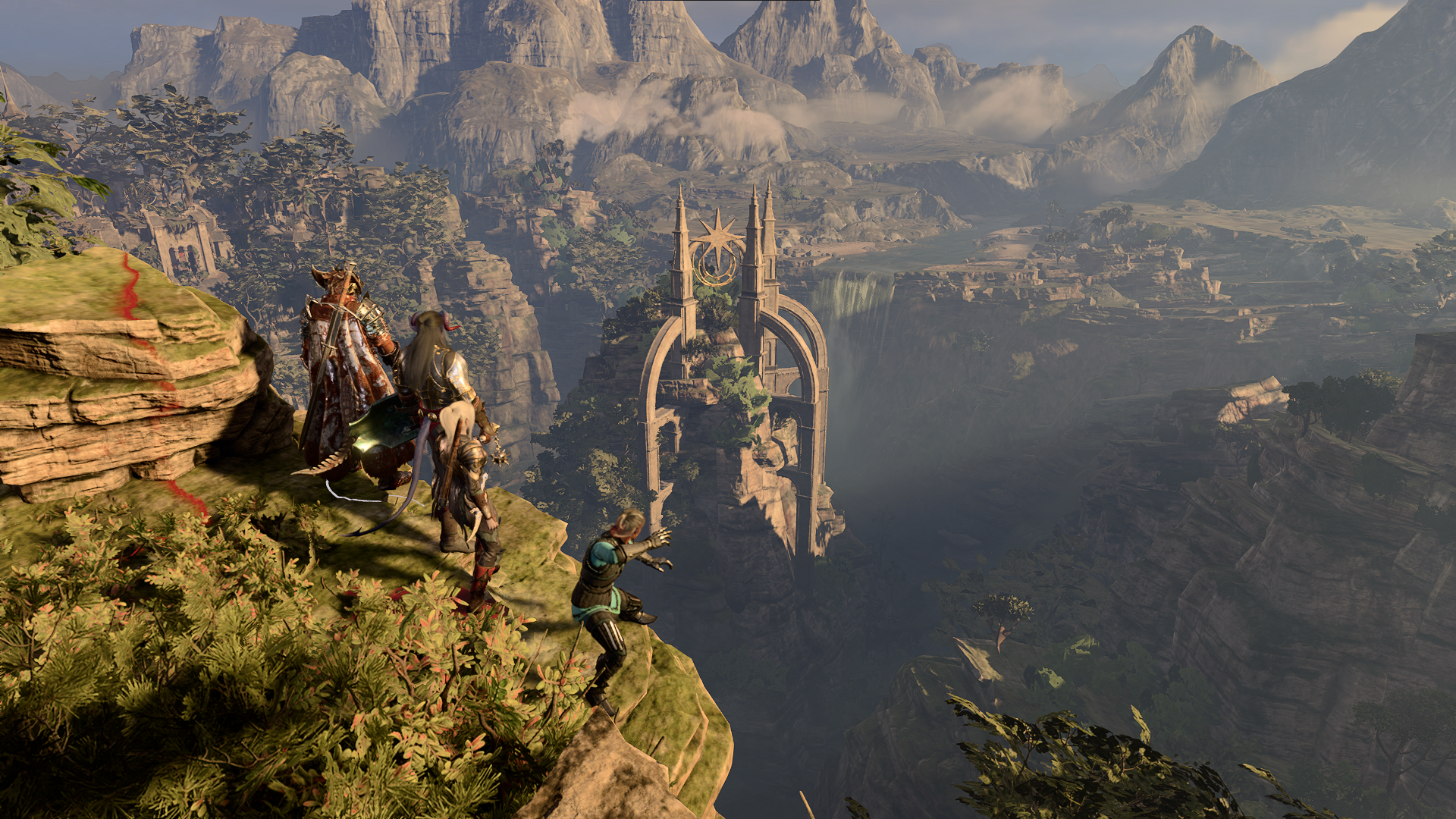
This deserves its own sentence because so little in the chronicle has been permitted to be simply beautiful. The road opened onto height and air. Far below, the valley stretched out under a pale sky, broken by rivers, stone bridges, old ruins, and the long mist of distance. For once, the world did not immediately ask the party to kill something in it.
Then the ghouls arrived, because the world can only restrain itself for so long.
They were dealt with. Compared to the goblin camp, the Underdark, Grymforge, Nere, the forge guardian, and the party's own handling of heavy machinery, the ghouls were less an event than an interruption. The party cleared them and returned to the cliff.
After that, they sat.
The chronicle records this with care. They sat around the mountain and looked down at the valley below. No one started an argument about a bow. No one pushed a witness into a river. No one sold a god, robbed a corpse, or tested a spell on livestock. For a little while, the company was only a company. They took a picture together at the edge of the world.
Nanang was barely in frame. Only his aura was.
This is perhaps the most accurate portrait of him the chronicle could have hoped for at the end: present, almost absent, impossible to place cleanly inside the borders of the image, but somehow affecting the whole composition.
VII. The Creche, and the Silence That Stayed
When Nanang became responsive again, the party continued to the creche.
The githyanki had built themselves into the bones of an old monastery, because Faerun has a talent for layering one kind of history over another until every building is at least three tragedies deep. There were soldiers, hatcheries, commanders, procedures, doctrines, and the enormous confidence of a people who consider most other peoples an error to be corrected.
As usual, the party killed everyone there.
The chronicle could dress this in the language of necessity. It could mention suspicion, incompatible objectives, the matter of the tadpoles, the dangerous machinery of the creche, or the githyanki's own lack of hospitality. These things may all be true. They do not change the practical shape of the event. The party entered. The creche became empty. The old monastery acquired another layer.
Nanang was responsive during this. He moved with them. He acted when action was required. He did not speak.
Not a little. Not occasionally. Not in a way the chronicle can soften into quietness. He said nothing at all. The party had once been able to distinguish his silence from his absence. By the creche, that distinction had begun to fail. He was awake, but no words crossed the distance from wherever he was to where the rest of them stood.
VIII. The Matter of the Tadpole, Remembered Briefly
After the creche, the party decided to go through the Shadow-Cursed Lands toward Moonrise Towers. Halsin had suggested this. The party forgot why for a moment.
Then they remembered the tadpoles.
The chronicle marks this because the tadpoles, despite being the central violation inside every skull present, had not recently received the attention one might expect from people carrying parasites with apocalyptic implications. The party had been busy. There had been bows to locate, camps to empty, ancient forges to operate incorrectly, and mountains to admire. The tadpole waited behind the eye with the patience of something confident that all roads still led back to it.
Moonrise, then. The tower. Ketheric Thorm. The Absolute. The next great shape of the story standing ahead in shadow.
The party proceeded.
IX. The Shadow-Cursed Land, and the Problem of Staying Together
The Shadow-Cursed Lands announced themselves in the way curses do when they have stopped pretending to be weather. Darkness pressed against the road. The air itself seemed hostile to the idea of unprotected life. To cross it, the party had to remain together, protected by what light and blessing they could maintain.
This was a massive issue for Traxex.
The requirement was simple: do not sprint ahead alone into the killing dark. Traxex, who has built much of her life around sprinting ahead alone into whatever is available, appears to have experienced this instruction less as guidance and more as a personal challenge issued by the terrain.
As soon as they stepped foot into the cursed land, she ran forward without notice.
She died.
The chronicle does not know what else to do with this information. It is too clean. Too structurally complete. A land that kills those who leave the light met the party member least suited to staying inside any defined radius, and the result occurred with the speed of a proof solving itself.
The party recovered her, or returned her, or otherwise continued with Traxex once more in a state compatible with travel. She did not, to the chronicle's knowledge, become slower.
X. Moonrise Towers, Ketheric Thorm, and the Night No One Followed
At last, the party reached Moonrise Towers.
The place rose out of the shadow with the confidence of a fortress that believed itself part of the curse rather than a thing caught inside it. There were guards. Cultists. Corridors heavy with the business of an enemy organization that had not yet understood what sort of people had been allowed through its doors.
There they found Ketheric Thorm.
His name had been mentioned several times by then. It carried weight in the mouths of others. It belonged to a man who should have drawn the party's focus by force of narrative gravity alone: general, tyrant, chosen, dead man walking, architect of the suffering that pressed around the lands outside his tower. The story around him was large. The stakes were large. The implications were standing in the room waving both arms.
The party did not appear to care very much.
This is not to say they failed to notice him. They noticed him. They simply did not give the gravity of the man the emotional space it seemed to request. The party has never been especially good at matching the tone of a room. A devil introduced himself and received small talk. A cult leader could do no better than mild registration.
They slept that night in Moonrise Towers.
That is the last event the chronicle can record with confidence.
XI. The Empty Page
There are reports. Not records. Reports.
Some say Nanang became an evil mage and killed everyone. The chronicle cannot confirm this, though it admits that if one were to search the company for the member most likely to become an evil mage without announcing the transition, Nanang's name would be difficult to avoid.
Some say Traxex could not contain herself, ran into the shadow again, and the party, grief-stricken beyond repair, lost the will to continue. The chronicle finds the first half plausible and the second half emotionally generous, but not impossible. Stranger things have happened. Some of them are recorded in the previous pages.
Some say they simply got bored and remained at Moonrise Towers, living among the cultists with the serene confidence of guests who had misunderstood the nature of the invitation and were too dangerous to evict.
The chronicle does not know.
What is clear is that there are no more pages. The record ends at Moonrise. Not with a final battle. Not with the tadpole drawn out and held up to the light. Not with Ketheric brought low or the Absolute named in full. It ends after a night inside the enemy's tower, with the party alive, armed, questionably motivated, and still together.
Perhaps that is enough.
Whether they ventured afterward into another realm together, or scattered into smaller companies, or whether Nanang finally found the rest that had been reaching for him across every other day, or whether Traxex found her bow in some place the river could not touch, or whether Anaik stood forever in iron, or Sogong found a different fish, or Nero took one last thing from the world and left no receipt behind: these are tales the chronicle cannot know.
What matters is this: they were here. They did these things. They were terrible at times, magnificent at others, and frequently difficult to distinguish between the two. The road did not finish where it should have. It finished where the record stopped.
Let no entry be lost. Let no deed go unrecorded.
Here the Ink Runs Out
Here the company passes beyond the page. Whatever followed belongs to another table, another silence, or another realm entirely.